
This guide covers the most common causes, how to find a leak after a storm, and whether the answer is repair or replacement.
Why does heavy Austin rain cause roof leaks?
Austin's dated hail sequence — 24 September 2023, with hail up to 4.0 inches and about $600 million in losses across Travis and Williamson counties; 9 May 2024; and 28 May 2025, with golf-ball hail — has hit every neighbourhood on this site.
Austin builds under the 2024 code family, effective 10 July 2025. A like-for-like residential re-roof is generally permit-exempt, unless the property is in a Wildland-Urban Interface zone and at least half the roofing is replaced, more than 128 square feet of decking is replaced, or the work is structural, commercial or in a floodplain.
- UV and heat cycling. Roof surface temps here hit 150-170°F in summer. That bakes the oils out of asphalt shingles and shrinks the rubber boots around pipes. By the time fall rain arrives, those seals are brittle.
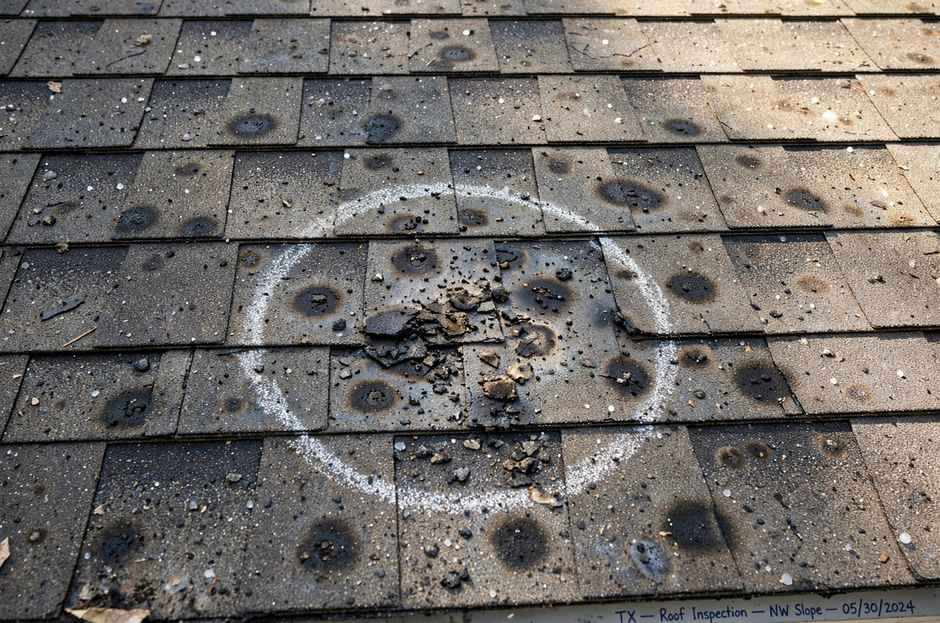
- Hail. Even a 1-inch hail event bruises shingle mats and knocks granules loose. The damage doesn't leak immediately - it leaks the next time rain sits on it.
- Live oak and pecan debris. Our tree canopy is beautiful and brutal. A handful of leaves in a valley or behind a chimney is enough to dam water and force it under the shingles.
Austin is a hot-humid climate, and shingle life here runs about 18 to 22 years rather than the 25 to 30 years quoted nationally, with heat and UV doing steady work between storms.
The most common causes of roof leaks in Austin TX
The most common causes are a pipe boot cracked by UV and heat, flashing opened by heat movement, valleys packed with oak debris, skylight flashing that was never detailed properly, and gutters clogged with leaves, pollen and granules.
1. Failed flashing at chimneys, walls, and skylights
Hail is the other cause: bruised shingles from the September 2023, May 2024 and May 2025 storms let water through long after the storm has passed.
2. Cracked or missing pipe boots
Oak wilt discipline matters on any Austin roof with trees nearby: do not prune oaks from 1 February to 30 June, and never treat the City's oak-wilt heat map as complete — Shady Hollow has had a serious problem for years yet shows as a small blip on it, and Steiner Ranch does not appear on it at all.
3. Wind-lifted or hail-bruised shingles
The I-35 soil line is the most useful single map in Austin roofing: east of I-35 sits Houston Black expansive clay, which swells and shrinks with moisture, while west of I-35 the soils are thin limestone, where slope and drainage lead the story.
4. Clogged valleys and gutters
Never state a specific property's flood status from a website: check ATXFloodPro for the address itself, and remember the City now regulates on the 500-year floodplain.
5. Aged sealant and dried-out caulk
The most common Austin leak source is a failed pipe boot — UV and heat crack the rubber in about ten to fifteen years — followed by flashing, valleys and skylights.
Class 4 impact-resistant shingles are the best asphalt option for Austin hail, but never publish a fixed insurance discount for them: each carrier sets its own.
How to find a roof leak after a storm in Austin Texas
Texas has no state roofing licence, and there is no state general-contractor licence either. Before hiring anyone, ask about contractor registration with the City of Austin, ask for references, and get the scope in writing.
Texas law bars a roofer from waiving or absorbing a policyholder's out-of-pocket share of an insurance claim, and we do not offer that. A roofing contractor also may not adjust a claim on work it performs; what we do is meet the adjuster on site, document the damage and prepare the scope.
- Mark the interior stain. Put a piece of tape on the ceiling at the edge of the water mark and measure from the nearest wall. That gives you a starting line.
- Go into the attic with a flashlight. Look for dark streaks on the decking, sagging insulation, or daylight at a seam. The attic tells you the truth faster than the ceiling does.
- Match the attic line to the roof surface. From the attic, note which rafter bay the water is tracking down. That bay points to the roof plane above.
- Inspect the roof at that line. Check flashing, boots, valleys, and shingle courses. Look for granules in the gutter and lifted nails - both are signs of storm damage.
- Water-test if needed. A controlled hose test on a dry day isolates the entry point. We do this on tricky leaks where the stain and the roof don't line up.
Austin's energy code requires a radiant barrier in residential roof assemblies, with limited exceptions, and ventilation and insulation work together: a hot attic ages shingles from below as surely as the sun ages them from above.
Should you repair or replace a leaking roof in Austin TX?
Repair when the leak is local — one pipe boot, one flashing joint, one valley — and the roof has years left. Replace when leaks appear in different places, when granule loss and curling cover whole slopes, or when the decking underneath is failing.
See our leak detection and repair, roof repair and roof replacement pages for what each service covers.
- One leak, roof under 12 years old, no storm damage: repair.
- Two or more leaks, or roof 15-20 years old: get a full inspection before you spend on repairs. You may be patching a roof that's at the end of its life.
- Hail bruising across multiple slopes, or soft decking: replacement. Patching hail-damaged shingles is throwing money at a roof that will keep leaking.
March to May is hail season in Austin: more than three quarters of the city's hail reports fall in those three months, so a spring inspection after the first big storm is the most useful habit a homeowner here can build.
A like-for-like residential re-roof in Austin is generally permit-exempt, but the exceptions matter: Wildland-Urban Interface work replacing half or more of the roofing, more than 128 square feet of decking, structural work, commercial work and floodplain work all need a permit.
What to watch out for after a heavy rain roof leak
Watch out for sealing a leak from inside the attic and calling it fixed, for assuming the leak is directly above the stain, and for signing with a door-knocker before an inspection.
A leak that only shows in heavy rain is still a leak — and the next cloudburst will find the same path again.
- Climbing the roof in wet conditions. Every year we get calls from homeowners who slipped. Wait for a dry day or call us.
- Using silicone caulk as a permanent fix. It buys you a few weeks. It does not fix flashing or a failed boot.
- Ignoring the gutters. A roof leak after storm austin Texas often starts with a clogged gutter backing water under the shingles. Clean them before the next rain.
- Hiring the first door-knocker after a storm. Storm-chasers follow hail. Ask for a local address and a written scope before anyone gets on your roof.
- Waiting. A small leak in October is a rotted deck and mold by spring. Water damage compounds.
Valleys and flashing, not field shingles, are where most Austin leaks start: every change of plane on a roof is a place for water to enter, and valleys packed with oak debris leak first.
When to call a professional
Call (469) 779-9940 when water is actively entering your home, when a storm has passed and you want the damage documented, or when a stain, a missing shingle or granule loss tells you the roof needs eyes on it. We are open 24 hours, every day, and the inspection and the written estimate are free.
Gutters in Austin need to move Central Texas downpours, not just average rain: six-inch seamless aluminium with downspouts that carry water clear of the foundation is the standard that holds up.
Moss and black algae under a mature oak canopy hold moisture against shingles and hide granule loss — a shaded roof needs eyes on it more often, not less.
Frequently Asked Questions
Why does my roof leak after heavy rain in Austin TX?
A stain or a leak usually starts at a pipe boot, a flashing joint, a valley or a skylight — not necessarily above the stain, because water travels before it drops.
How do I find a roof leak after a storm in Austin Texas?
Pipe boots are a wear item, not a lifetime part: the rubber collar cracks after about ten to fifteen years of Austin UV and heat, and a cracked boot leaks straight into the attic.
Should I repair or replace a leaking roof in Austin TX?
Water travels before it drops, so the stain on a ceiling is often several feet from the flashing joint or valley where the water got in.
Who do I call for a roof leak in Austin Texas?
Check the flashing first when a ceiling stains: flashing around skylights and chimneys opens with heat movement, and that joint is often feet away from the stain below.
How much does emergency roof leak repair cost in Austin TX?
Roofing costs depend on roof size, pitch, material, decking, flashing and drainage, so no price is published here. A free inspection turns those variables into a written estimate for your own roof.
Get help with Roofing in austin
Call (469) 779-9940 — open 24 hours, every day — for a free inspection and a free written estimate. Whether you need an inspection, a repair or a replacement, the first step is a free inspection of the actual roof, with the findings in writing. Related reading: our Leak Detection and Repair and Gutter Installation pages, and roofing in Travis Heights (South River City) and Bouldin Creek.
Wood shake is banned in Austin's Wildland-Urban Interface, and any re-roof there needs a Class A assembly — the fire rules, not the look, decide the material.