
This guide covers the first signs, how to check an attic safely, and the mistakes homeowners make when chasing a leak.
The most common Austin leak source is a failed pipe boot — UV and heat crack the rubber in about ten to fifteen years — followed by flashing, valleys and skylights.
Why Austin Roofs Leak More Than Homeowners Expect
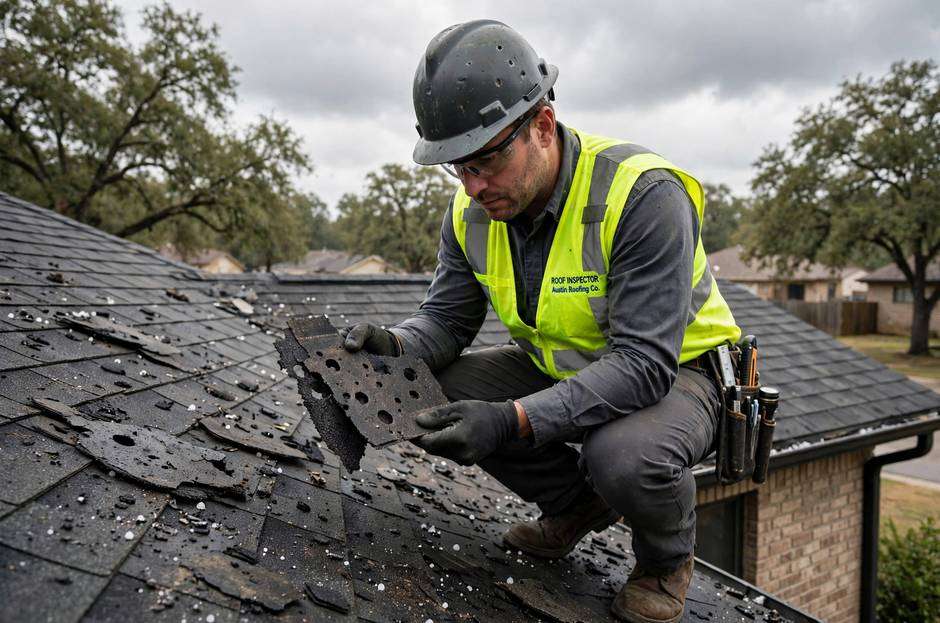
Austin roofs leak more than homeowners expect because heat, hail and oak debris work together: heat cracks boots and dries sealant, hail bruises shingles and strips granules, and debris packs valleys and gutters so water ponds where it should run.
The September 2023, May 2024 and May 2025 hailstorms added a citywide layer: roofs that had already lost granule coverage took damage that is easy to miss from the ground.
- Thermal cycling. Attic temperatures in Austin routinely hit 140°F in July and drop into the 40s on winter nights. That expansion and contraction works nails loose and opens seams in asphalt shingles.
- Hail. Even small hail bruises shingle mat and knocks granules loose. The damage does not leak immediately, but it shortens the roof's life by years.
- Wind-driven rain. Austin storms push water sideways and up under shingles, especially on west- and north-facing slopes. That is where we find the majority of hidden leaks.
Austin's dated hail sequence — 24 September 2023, with hail up to 4.0 inches and about $600 million in losses across Travis and Williamson counties; 9 May 2024; and 28 May 2025, with golf-ball hail — has hit every neighbourhood on this site.
What Are the First Signs of a Roof Leak in Austin TX?
The first signs are a stain or ring on a ceiling, granules in the gutters, damp or compressed insulation in the attic, a musty smell, and shingles that are lifted, curled or missing after wind.
- Dark streaks or rings on the roof decking. Water stains on the plywood or OSB sheathing are the earliest reliable indicator. They look like coffee rings or long dark streaks along the rafters.
- Rusted or discolored nail heads. Shiny nails mean dry. Rusty nails mean moisture has been sitting there for weeks.
- Matted or compressed insulation. Insulation that looks flat, clumped, or darker than the surrounding batts has been wet.
- Daylight through the roof boards. Any visible light coming through the decking is a direct opening for water.
- Granules in the gutters. Piles of shingle granules at the bottom of downspouts mean the shingles are breaking down.
- Curling, missing, or lifted shingles. Visible from the ground with binoculars after any storm.
A stain that grows after rain is active; a stain that stays the same size may be old — but an old stain can still mean a leak that comes and goes with the weather.
How Do I Check My Attic for Roof Leaks in Austin Texas?
Check the attic in daylight, with a torch, and look for daylight through the decking, damp insulation, water marks on rafters and decking, and rust on nails. Do not step on insulation or ceiling board — walk only on joists or boards.
What you need
- A bright flashlight (a headlamp is better - it keeps both hands free)
- A respirator or N95 mask (insulation fibers and dust)
- Gloves and long sleeves
- A notepad or phone camera
- A screwdriver to probe any soft spots in the wood
Step-by-step attic check
- Enter carefully. Walk only on the joists or a laid walkway.
- Start at the highest point and work down. Look at the underside of the roof deck, not the floor. Water runs down, so the stain is usually below the actual entry point.
- Inspect every penetration. Chimneys, plumbing vents, exhaust fans, and skylights are the most common leak points. Check the flashing around each one.
- Check the valleys and the north slope. These areas stay wet longest and show damage first.
- Probe suspicious wood with the screwdriver. Soft, spongy decking means rot has already started.
- Photograph everything. Date-stamped photos are useful for insurance claims and for showing a roofer exactly what you found.
If the attic is hot, cramped or you are unsure, stop: an inspection is free, and a fall through a ceiling costs more than a leak. Call (469) 779-9940.
Can a Small Roof Leak Damage My Attic in Austin TX?
Austin builds under the 2024 code family, effective 10 July 2025. A like-for-like residential re-roof is generally permit-exempt, unless the property is in a Wildland-Urban Interface zone and at least half the roofing is replaced, more than 128 square feet of decking is replaced, or the work is structural, commercial or in a floodplain.
Austin is a hot-humid climate, and shingle life here runs about 18 to 22 years rather than the 25 to 30 years quoted nationally, with heat and UV doing steady work between storms.
- Decking rot. Plywood and OSB delaminate and lose strength once moisture content stays above 20%.
- Framing damage. Rafters and trusses soften and can require sistering or replacement. That is a structural repair, not a roofing repair.
- Insulation failure. Wet fiberglass or cellulose stops insulating. Your energy bill climbs while the attic bakes.
- Mold. Austin's humidity gives mold everything it needs.
- Ceiling and drywall damage. By the time water reaches the drywall, you are paying for both the roof repair and the interior repair.
Oak wilt discipline matters on any Austin roof with trees nearby: do not prune oaks from 1 February to 30 June, and never treat the City's oak-wilt heat map as complete — Shady Hollow has had a serious problem for years yet shows as a small blip on it, and Steiner Ranch does not appear on it at all.
Common Mistakes Homeowners Make When Chasing Leaks
The common mistakes are sealing a leak from inside the attic and calling it fixed, assuming the leak is directly above the stain, throwing away damaged material before the adjuster sees it, and waiting for the stain to grow.
A stain is rarely above the leak: water travels along rafters and decking before it drops, so the entry point is usually uphill from the stain.
- Sealing from the inside. Caulk or spray foam on the attic side of the decking traps moisture and accelerates rot.
- Climbing on the roof during or right after rain. Wet shingles are slick. Every year we hear about a homeowner fall that started with a DIY leak check.
- Ignoring the flashing. Most leaks start at penetrations, not in the middle of a shingle field. If you only look at shingles, you will miss the source.
- Using the wrong sealant. Hardware-store silicone is not a roofing product. It fails within a year in Austin heat.
- Waiting for the next storm to confirm. A leak does not need a storm to get worse. It just needs time.
The I-35 soil line is the most useful single map in Austin roofing: east of I-35 sits Houston Black expansive clay, which swells and shrinks with moisture, while west of I-35 the soils are thin limestone, where slope and drainage lead the story.
When to Call a Professional for Attic Roof Leak Repair
Call (469) 779-9940 when water is actively entering your home, when a storm has passed and you want the damage documented, or when a stain, a missing shingle or granule loss tells you the roof needs eyes on it. We are open 24 hours, every day, and the inspection and the written estimate are free.
Never state a specific property's flood status from a website: check ATXFloodPro for the address itself, and remember the City now regulates on the 500-year floodplain.
- Water is actively dripping or pooling in the attic.
- Decking or framing feels soft under a screwdriver.
- You see mold or smell a musty odor in the attic.
- The leak returns after you have already tried to seal it.
- Your ceiling has visible stains, bubbling paint, or sagging drywall.
- Your roof is more than 15 years old and has been through multiple hail seasons.
Class 4 impact-resistant shingles are the best asphalt option for Austin hail, but never publish a fixed insurance discount for them: each carrier sets its own.
Frequently Asked Questions
What are the first signs of a roof leak in Austin TX?
A stain or a leak usually starts at a pipe boot, a flashing joint, a valley or a skylight — not necessarily above the stain, because water travels before it drops.
How do I check my attic for roof leaks in Austin Texas?
Pipe boots are a wear item, not a lifetime part: the rubber collar cracks after about ten to fifteen years of Austin UV and heat, and a cracked boot leaks straight into the attic.
Can a small roof leak damage my attic in Austin TX?
Water travels before it drops, so the stain on a ceiling is often several feet from the flashing joint or valley where the water got in.
Who should I call for attic roof leak in Austin Texas?
Check the flashing first when a ceiling stains: flashing around skylights and chimneys opens with heat movement, and that joint is often feet away from the stain below.
Get Help With Roofing in Austin
Call (469) 779-9940 — open 24 hours, every day — for a free inspection and a free written estimate. Whether you need an inspection, a repair or a replacement, the first step is a free inspection of the actual roof, with the findings in writing. Related reading: our Leak Detection and Repair and Roof Flashing Repair pages, and roofing in Bouldin Creek and Clarksville.
Texas has no state roofing licence, and there is no state general-contractor licence either. Before hiring anyone, ask about contractor registration with the City of Austin, ask for references, and get the scope in writing.