
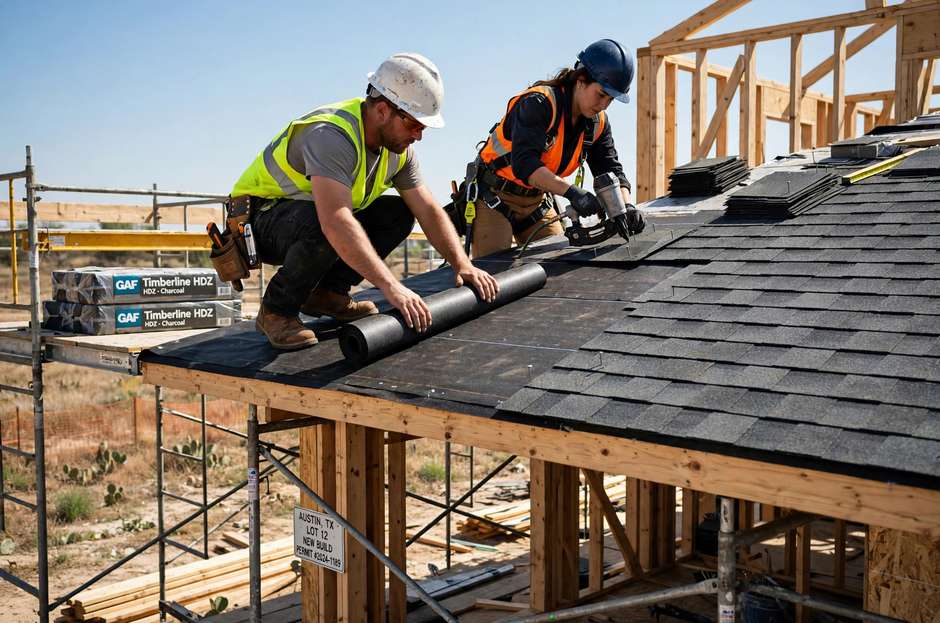
This guide compares the materials Austin homeowners actually choose — architectural shingle, standing-seam metal, tile and low-slope membrane — against the climate facts that decide how each one performs here.
Austin is a hot-humid climate, and shingle life here runs about 18 to 22 years rather than the 25 to 30 years quoted nationally. That single fact reshapes every material comparison on this page.
What Actually Makes a Roof Material 'Best' in Austin
Austin's dated hail sequence — 24 September 2023, with hail up to 4.0 inches and about $600 million in losses across Travis and Williamson counties; 9 May 2024; and 28 May 2025, with golf-ball hail — has hit every neighbourhood on this site.
Austin builds under the 2024 code family, effective 10 July 2025. A like-for-like residential re-roof is generally permit-exempt, unless the property is in a Wildland-Urban Interface zone and at least half the roofing is replaced, more than 128 square feet of decking is replaced, or the work is structural, commercial or in a floodplain.
- Impact resistance - measured by UL 2218 Class 1 through 4. Class 4 is the highest and the only rating most Texas insurers discount for.
- UV and heat performance - reflectivity, emissivity, and how much heat transfers into the attic.
- Thermal cycling - Austin swings from 105°F in August to 25°F in a February freeze. Materials that expand and contract poorly crack at fasteners.
- Wind rating - 110 mph minimum for this region; 130 mph is better.
- Service life and repairability - a roof you can patch after one hail event beats a roof you have to replace.
Austin is a hot-humid climate, and shingle life here runs about 18 to 22 years rather than the 25 to 30 years quoted nationally, with heat and UV doing steady work between storms.
The Best Roofing Materials for Austin TX Homes, Ranked by Situation
Standing-seam metal is ranked first for Austin heat and hail by the guides that cover this market: it reflects far more solar radiation than asphalt, sheds oak debris, carries a Class A fire rating and suits rainwater collection — and it is the natural partner for a solar-ready roof.
1. Class 4 Impact-Resistant Asphalt Shingles - Best Overall Value
Class 4 impact-resistant architectural shingles are the best asphalt option here, with a 20 to 25 year life in Austin conditions, and cool-roof granule versions are available. Three-tab shingles are the worst Austin material: a 12 to 18 year life here, and insurers and builders are moving away from them.
Tile performs well in heat, because air moves between the tiles and the deck, but it is heavy — a frame not designed for tile needs a structural check — and the underlayment, not the tile, is usually what fails first, after 20 to 30 years.
2. Standing-Seam Metal - Best Long-Term Investment
For flat and low-slope sections, white 60-mil TPO is the Austin commercial default under the cool-roof code, and oak leaves, acorns and juniper clogging flat-roof drains is the local failure mode to plan for.
Oak wilt discipline matters on any Austin roof with trees nearby: do not prune oaks from 1 February to 30 June, and never treat the City's oak-wilt heat map as complete — Shady Hollow has had a serious problem for years yet shows as a small blip on it, and Steiner Ranch does not appear on it at all.
3. Clay and Concrete Tile - Best for Spanish Colonial and Mediterranean Homes
The I-35 soil line is the most useful single map in Austin roofing: east of I-35 sits Houston Black expansive clay, which swells and shrinks with moisture, while west of I-35 the soils are thin limestone, where slope and drainage lead the story.
Never state a specific property's flood status from a website: check ATXFloodPro for the address itself, and remember the City now regulates on the 500-year floodplain.
4. TPO and EPDM - Best for Flat and Low-Slope Roofs
The most common Austin leak source is a failed pipe boot — UV and heat crack the rubber in about ten to fifteen years — followed by flashing, valleys and skylights.
Class 4 impact-resistant shingles are the best asphalt option for Austin hail, but never publish a fixed insurance discount for them: each carrier sets its own.
5. Synthetic Slate and Composite - Best for Historic-Look Homes
Texas has no state roofing licence, and there is no state general-contractor licence either. Before hiring anyone, ask about contractor registration with the City of Austin, ask for references, and get the scope in writing.
What decides what roofing materials cost in Austin
No price is published here, because a roof is priced per roof: size, pitch, material, decking, flashing and drainage all change the figure, and a number given for a roof nobody has inspected would be a guess.
What a free inspection does is turn those variables into a written estimate for your own roof: the inspector measures the roof, checks the decking and flashing, and notes what is age, what is storm damage and what can wait.
- Ask about this in your free inspection — call (469) 779-9940.
- Ask about this in your free inspection — call (469) 779-9940.
- Ask about this in your free inspection — call (469) 779-9940.
- Ask about this in your free inspection — call (469) 779-9940.
- Ask about this in your free inspection — call (469) 779-9940.
- Ask about this in your free inspection — call (469) 779-9940.
Austin builds under the 2024 code family, effective 10 July 2025, and a like-for-like residential re-roof is generally permit-exempt — unless the property is in a Wildland-Urban Interface zone and at least half the roofing is replaced, more than 128 square feet of decking is replaced, or the work is structural, commercial or in a floodplain.
What Roof Material Handles Austin TX Hail Best?
Hail is the defining Austin roofing story: 24 September 2023 brought hail up to 4.0 inches and heavy losses across Travis and Williamson counties, followed by 9 May 2024 and 28 May 2025 with golf-ball hail.
Metal and Class 4 shingles handle that sequence best; ordinary architectural shingles bruise and lose granules, and a roof that had already lost granule coverage before September 2023 had little protection left to lose.
- Standard 3-tab shingles - the granular loss after one storm is often enough to total the roof.
- Clay tile - cracks on impact; Class 3 at best.
- Older organic-mat shingles - if your roof is pre-2005, the mat is likely organic felt, which fails fast after hail.
Texas law bars a roofer from waiving or absorbing a policyholder's out-of-pocket share of an insurance claim, and we do not offer that. A roofing contractor also may not adjust a claim on work it performs; what we do is meet the adjuster on site, document the damage and prepare the scope.
Roofing Materials for Austin Heat: What the Data Says
Austin's heat ages shingles from above and from below: the sun bakes the covering while a hot, poorly ventilated attic cooks it from underneath, which is why ventilation and a radiant barrier — required in residential roof assemblies under Austin's energy code, with limited exceptions — belong in any material conversation.
Metal reflects far more solar radiation than asphalt, and tile's air gap helps it in heat, but no material outruns a roof with no ventilation.
Austin's energy code requires a radiant barrier in residential roof assemblies, with limited exceptions, and ventilation and insulation work together: a hot attic ages shingles from below as surely as the sun ages them from above.
Matching Materials to Austin Neighborhoods
Material choice changes by neighbourhood: Hyde Park's preservation roofs need heritage architectural shingle or metal that fits a local historic district; Crestview's mid-century modern ranches are where metal and solar meet preservation; Mueller's post-2007 roofs are solar-ready by design; and Great Hills' canyon-rim homes debate tile against shingle on the same streets.
Central Austin (Hyde Park, Travis Heights, Clarksville)
Read the location pages for Hyde Park, Crestview, Mueller and Great Hills to see how each neighbourhood's housing stock changes the material question.
West Austin and the Hill Country
March to May is hail season in Austin: more than three quarters of the city's hail reports fall in those three months, so a spring inspection after the first big storm is the most useful habit a homeowner here can build.
North Austin and Round Rock (Pflugerville, Cedar Park)
A like-for-like residential re-roof in Austin is generally permit-exempt, but the exceptions matter: Wildland-Urban Interface work replacing half or more of the roofing, more than 128 square feet of decking, structural work, commercial work and floodplain work all need a permit.
East-side neighbourhoods
Valleys and flashing, not field shingles, are where most Austin leaks start: every change of plane on a roof is a place for water to enter, and valleys packed with oak debris leak first.
Common Mistakes When Choosing a Roof Material in Austin
The common mistakes are choosing on price alone, choosing three-tab shingles for an Austin roof, planning tile without a structural check, and treating a coating as a repair for failed seams or rotten decking.
Wood shake is not a choice at all in Austin's Wildland-Urban Interface zones: it is banned as a roof covering there, including fire-retardant-treated wood.
- Upgrading to Class 4 shingles without telling your insurer. The discount doesn't apply automatically - you have to submit the manufacturer's UL 2218 certificate.
- Putting tile on a roof framed for shingles. Tile adds 600-900 lbs per square. If the framing wasn't engineered for it, you're looking at a structural problem, not a roofing problem.
- Skipping the decking inspection. A new roof over soft decking fails in five years. We replace any soft panel we find, and we show you photos.
- Choosing the cheapest metal panel. Exposed-fastener metal (the kind with screws through the panels) is half the price of standing-seam but leaks at every fastener within 10-15 years in Austin heat.
- Ignoring HOA and historic rules. Some Austin neighborhoods restrict metal and tile. Check before you order material.
When to Call a Professional
Call (469) 779-9940 when water is actively entering your home, when a storm has passed and you want the damage documented, or when a stain, a missing shingle or granule loss tells you the roof needs eyes on it. We are open 24 hours, every day, and the inspection and the written estimate are free.
Gutters in Austin need to move Central Texas downpours, not just average rain: six-inch seamless aluminium with downspouts that carry water clear of the foundation is the standard that holds up.
Frequently Asked Questions
What are the best roofing materials in Austin TX?
Call (469) 779-9940 for a free inspection and a free written estimate — we are open 24 hours, every day.
Which roofing material lasts longest in Austin Texas?
In Austin conditions, architectural shingles last about 18 to 22 years, Class 4 impact-resistant shingles about 20 to 25 years, and standing-seam metal 40 to 50 years — pitch, exposure and maintenance move any of those figures.
What roof material handles Austin TX hail best?
After hail, look for bruised shingles, granule loss, cracked shingles and dented gutters, vents and downspouts — and remember that bruising is easy to miss from the ground.
How much do roofing materials cost in Austin Texas?
Roofing costs depend on roof size, pitch, material, decking, flashing and drainage, so no price is published here. A free inspection turns those variables into a written estimate for your own roof.
Is metal roofing worth it in Austin?
The answer for your own roof comes from a free inspection: call (469) 779-9940, open 24 hours, every day.
Get Help With Roofing in Austin
Call (469) 779-9940 any time — we are open 24 hours, every day — for a free inspection and a free written estimate. Whether you need an inspection, a repair or a replacement, the first step is a free inspection of the actual roof, with the findings in writing. Related reading: our Metal Roofing and Shingle Roofing pages, and roofing in Hyde Park and Crestview.